A version of this essay was also published in the travel journal Panorama. It has been reproduced here in its entirety.
The sun is at its zenith when I leave Madras behind. But for the rickety suburban train – which must have been born in Derby before Independence – where I am fortunate enough to get a berth this busy Sunday afternoon, I would have had to rely on the buses, which ply frequently between the capital of Tamil Nadu and Kanchipuram, the capital of the Pallavas. An hour later, I have still not crossed Tambaram, and it seems as good a time as any to indulge in the hedonistic delights of the road: a paper cup filled with medu and dal vadas.
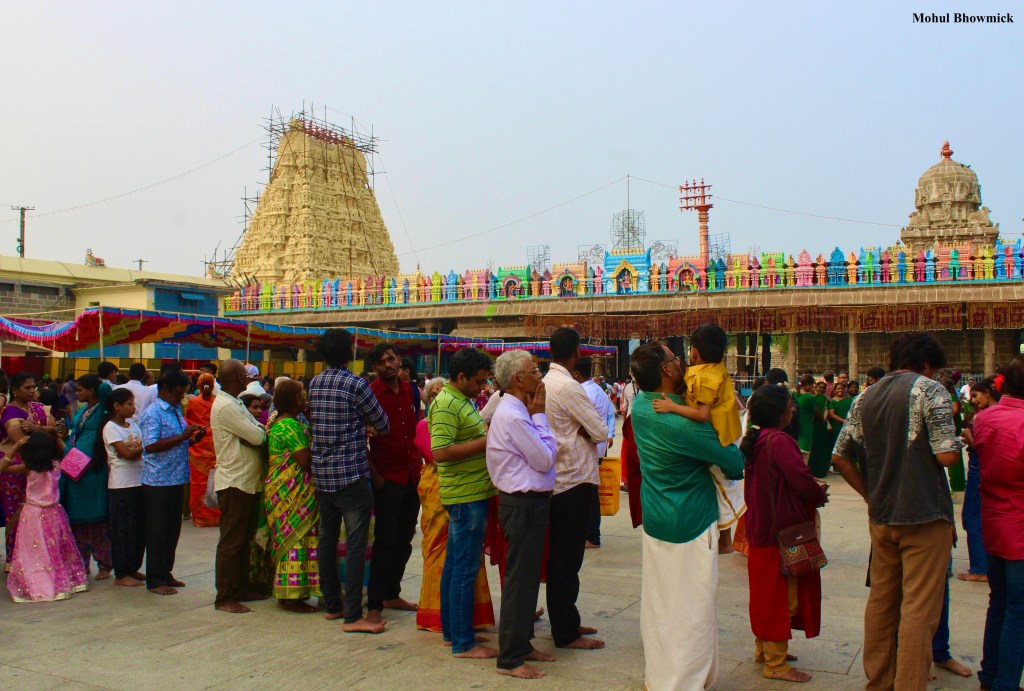
All I need now are strong cups of filter coffee to wash these down, but the lush greenery of the prosperous Coromandel countryside forbids thoughts of such reclusion. The train snakes its way into Chengalpattu an hour behind time. Much to our horror, it makes a 180-degree turn here before launching forth into another route. A horde of women dressed in a ravenous shade of red — pilgrims bound for Kanchipuram, as their garb suggests — affords me the confidence of being on the right path.
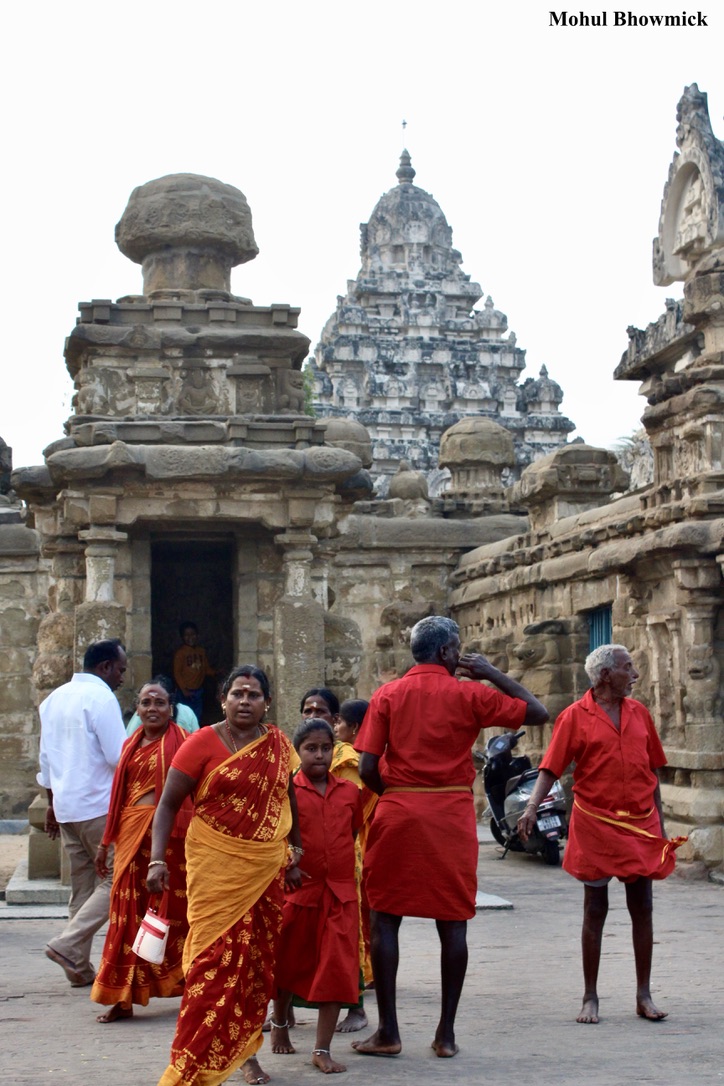
For a couple of months every year, these women (and sometimes men) give up the sensory pleasures of the world (I am still reeling under the delights of the dal vadas) and practice harsh austerities to please the goddess Meenatchi, who has her abode in central Kanchi. They eat uncooked food, sometimes without any seasoning; they sleep on the floor, forsaking the comforts of a bed; they wake at dawn to make offerings and sleep soon after sundown; they do not weep openly in times of grief, anxious not to offend the goddess. Many whom I meet on the train are only halfway through their self-imposed rigours; by the time I leave the Coromandel, several would have given up and got down from this spiritual mountain.
A mild-mannered, dark-complexioned girl of about twelve, dressed in a similar red, curls up next to me. She stares openly, possibly drawn by the aroma of the dal vadas, but shakes her head vigorously when offered a tidbit.
“My mother tells me that I must not eat cooked food at this time of the year,” she proffers matter-of-factly. “If I do so, the goddess Meenatchi will wreak havoc on our family.”
“Is that so?” I ask, genuinely curious.
“Indeed. My grandmother says that our farms will bear no crops if we displease the goddess in any way.” She looks away at the completion of her sentence.
My hands stop midway to my mouth, and I do not reach for my vadas until the best part of an hour has passed by. What gives her the strength to refuse? To resist takes as much courage, if not more, than to destroy, and I am ashamed (not for the vadas; it is no fault of theirs) at my inability to see her for who she is. The vadas have turned cold by now. The girl smiles and sips water from a bottle, but beneath the smile I sense a solemn commitment to the dignity of her forebears—ingrained, I surmise, too deep to question.
Like others before her, and many after her, she has been consumed by dogmas that value the surrender of joy as the greatest of all sacrifices — an idea that I, who have spent the morning indulging in dal vadas, find difficult to honour. I catch myself imagining the life that awaits her: the aunts and sisters who will approve, the school friends who will not understand, the years of submission to a goddess she has never seen. It is an ungenerous imagining, and I know it. She has refused my vada with more conviction than I have brought to anything this morning.
And yet, here I am, getting off in Kanchipuram to do exactly what she is doing — seeking something in these temples, though I cannot say what. I disembark off at the near-empty railway platform Kanchipuram, two hours behind time. The sun has reached its prime and will soon seek the comfort of dusk. I move towards the exit, only to be careened forth into the arms of an autorickshaw driver. He is nearly seven feet tall, dark-complexioned, with unkempt hair that curls up his neck, and looks like he wrestles for fun on his days off. His demeanour, as he beseeches me to use his services, appears even-tempered. He promises to take me to and explain the historical significance of fifteen temples in the two hours of daylight I have. He’ll also throw in a visit to a saree factory (Kanchipuram is known for its silks) as a concession.
***
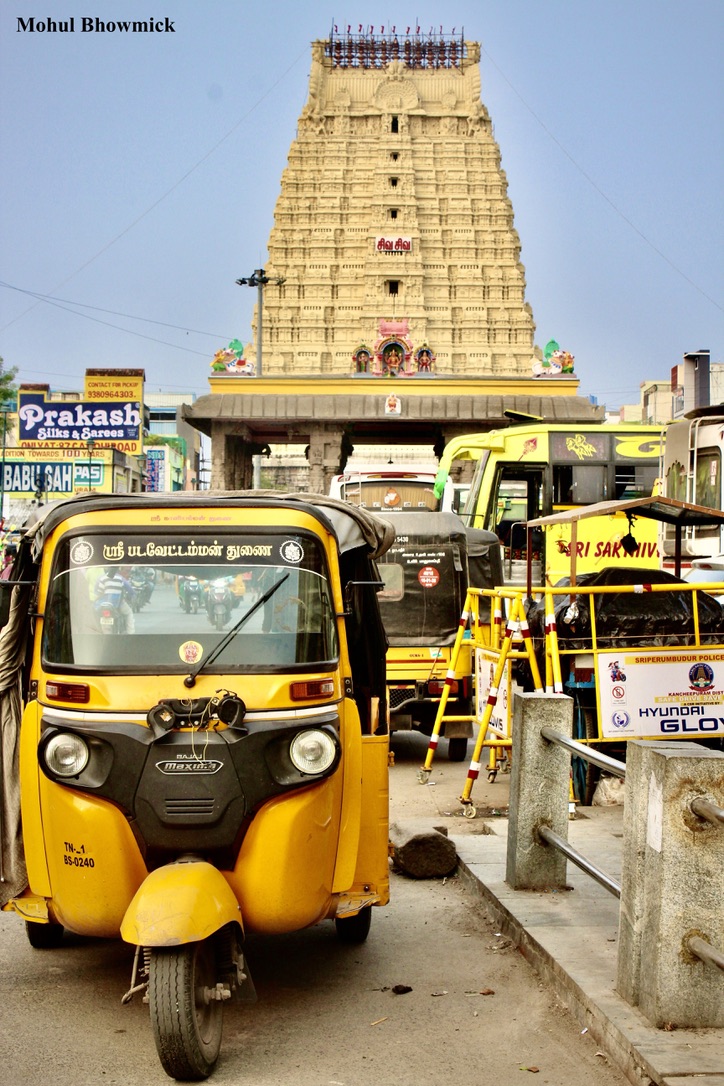
There is not a soul in sight in Kanchipuram. I give in to his offers, jump into his rickshaw, and ask to be shown just one temple for now: the Ekambaranathar. The afternoon heat has ensured that most shops in the bazaars are shut, their keepers having trudged back home for well-deserved siestas. Located at the centre of the town, quite close to the famous Meenatchi Amman Temple, the Ekambaranathar also has a quaint, if slightly unkempt, pond on its premises. When I bend to tie my shoelaces, hordes of women in red scatter past. The gates of the temple have just opened, and they want to be first to seek the blessings of Siva, worshipped widely in his equanimous form in the Coromandel.
The Kailasanatha, which every autorickshaw driver insisted lies far outside town and would not approach for less than five hundred rupees, turns out to be less than two kilometres away. An ageing driver, seemingly worn with boredom, with a toothy smile that brooks no malice, eventually settles for three hundred for a journey that takes no more than ten minutes.
I thank him for his warm hospitality and for the chance of riding in his esteemed chariot, which must have been a fine diesel engine during the reign of the Pallavas, but now reeks of disuse and disease.
“Ungal anbaana ubacharippirku nandri, anna,” I say in pidgin Tamil. Thank you, brother, for your warm hospitality.
He does not deem me important enough to remove the beedi from his mouth and respond before turning around in the dust and heading back to town. The money he has extorted out of me is equivalent to two bottles of country-made liquor.
The contrast his chariot shares with our destination, the Kailasanatha, could not have been starker.
***
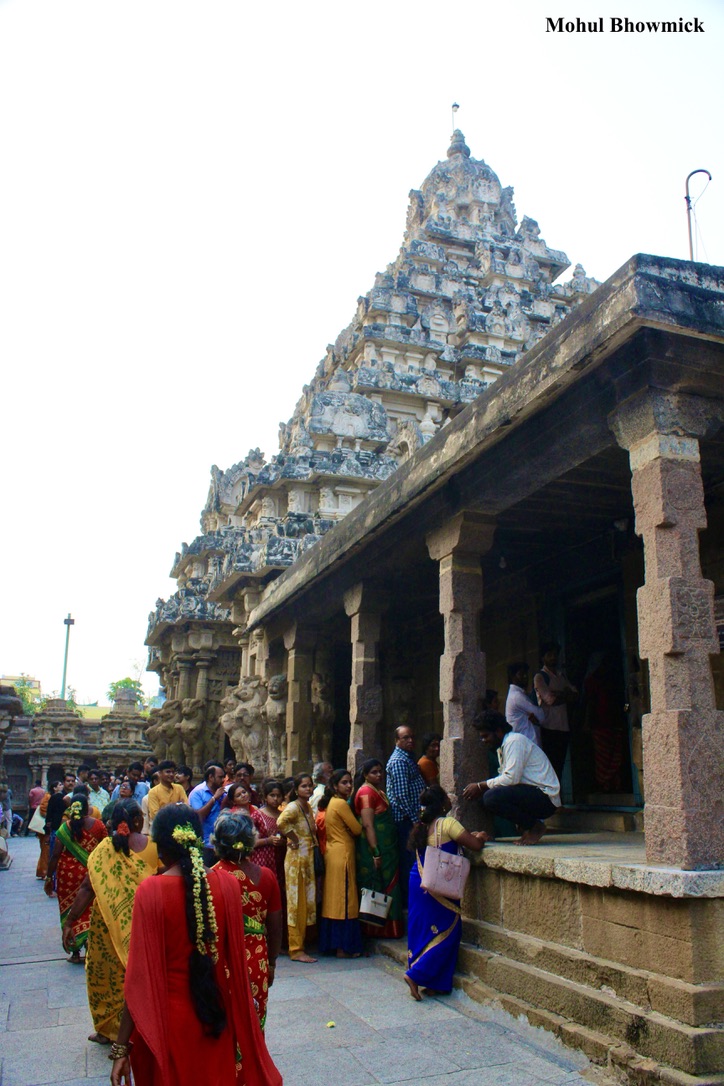
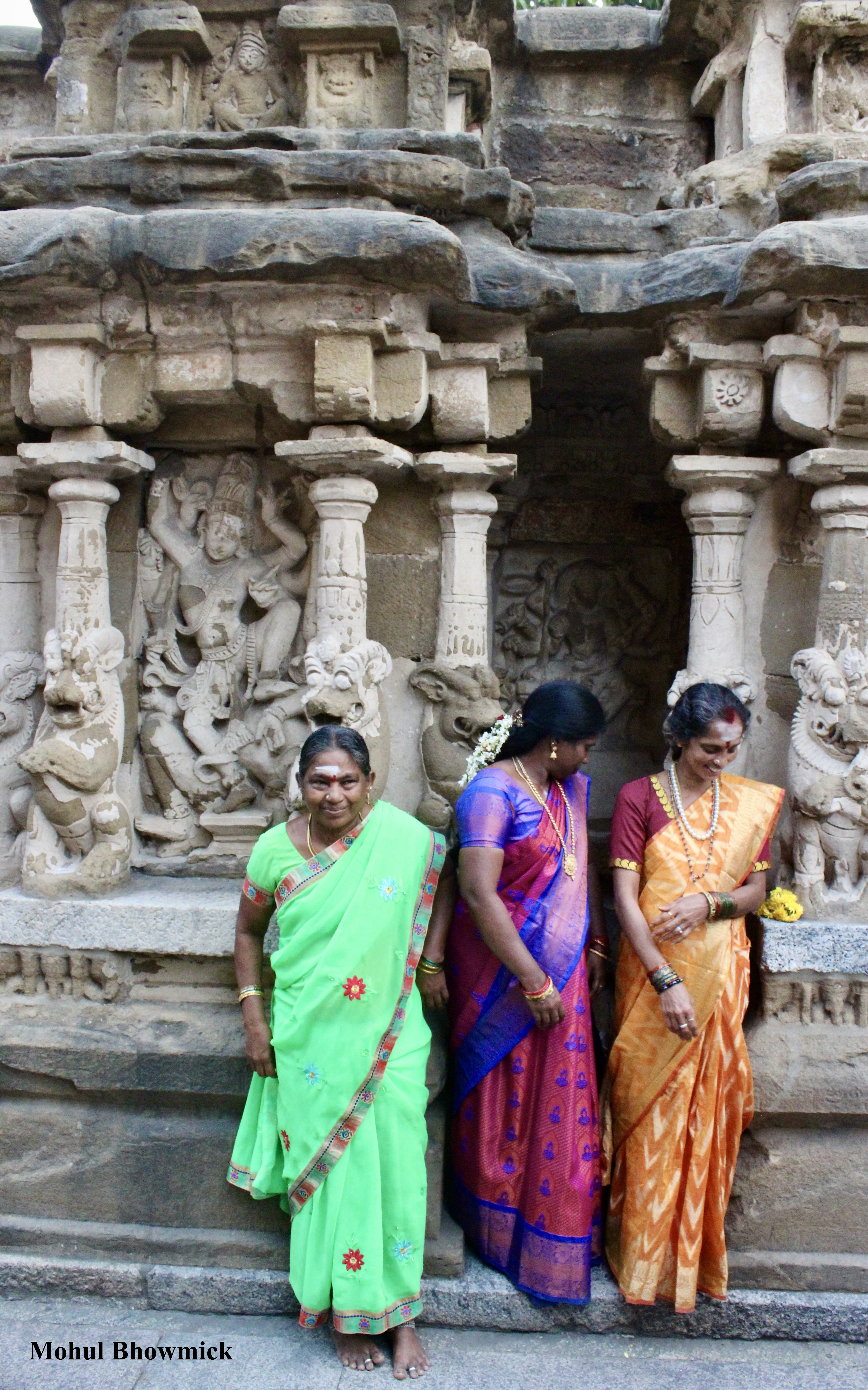
Built in the heyday of the Pallavas, of whom very little is known among the Tamils owing to the coastal, chest-thumping, valour-parading (as well as the pillaging, arsoning, and monastery-destroying) Cholas, the Kailasanatha is from another lifetime. The stones welcoming me from the south harass the hurried traveller; on the eastern front, the facade invites me for a glass of warm milk. In the pillared halls inside, where even Vikramaditya II of the Chalukyas left an inscription after routing his hosts in the 8th century AD, I understand that eternity is not remote; it is here, right beside me.
Mythical lions, of whom all warrior-kings were fond, are found in numbers of four, while murals from the epics, as well as the Puranas, line the walls of the Kailasanatha. Here, Siva is seen enacting the various lores associated with him; he cuts off the fourth head of Brahma here, and he reduces Kama to ashes with his third eye there. The Yakshas, who have often been thought of as the predecessors of the Brahmanical deities one sees today, abound aplenty on the western walls of the temple; they lie comfortably distant from the raging Siva, seeking solace in the latter’s more benevolent form, where he drapes snakes around his neck, rides a bull and sleeps on cremation grounds.
Even Rajaraja I, credited for reviving the Cholas, is known to have taken inspiration from the Kailasanatha while building his famous Rajarajesvara in Thanjavur. It is certainly the pièce de résistance of all Tamil architecture I have seen, solely due to its filigreed pillars and intricate hand-carvings on all four sides in an age where machines could hardly have been imagined, let alone used. The sanctum santorum, in the manner of all temples in southern India, is a darkened hall where only the bravehearted and non-asthmatic traveller can go. The linga of Siva is seen only with the help of halogens; in this dim, ancient light, where the walls threaten to cave in any moment, the priest with his orange-coloured iPhone looks akin to a poet at a nightclub.
***
The hike back to town is equally impressive, if not more: a Carnatic music-enthused sibling duo give me a lift on their autorickshaw. They ask me not to pay in cash, but with my life, as the driver secures himself on a cushion in front, and I am left dangling in the air without the comfort of a seat or the security of a bar to hang on to. His wide handlebars promise some support, but the rods to which the rear-view mirrors are attached appear more tempting. Twice, he swerves dangerously close to eddies of wet mud on which water buffaloes linger as if they were in the Welsh countryside. I take heart from the fact that the journey cannot take more than ten minutes; when it does, I am calmed only by the choicest serving of Kanchi’s best idlis bejewelled with cashew nuts imported from the Goan coast and a hot cup of filter coffee.
The coffee is not as I had imagined it to be when leaving Madras earlier in the day; a false sense of intimacy that I had felt with the world in general (and my country in particular) is fading faster than the speed of light. A world, such as the one I existed in and yet never understood, has unravelled in front of my eyes. The lustre of such faith may never attract me into its presence, but that thousands (if not millions) of my compatriots engaged with it, sometimes unknowingly and sometimes consciously, is no longer beyond me.
Almost invisibly, a line has been drawn that I can only hope to cross in this lifetime. To them, the assurance of a power bigger than themselves is enough for a comfortable night’s sleep. For me, the questioning of untested logic remains the biggest barrier to entry. Quietly, and almost as an aside, I tell myself that I must stand apart to get admitted into this inner sanctum. They were too close to understand their faith; I was too far to fathom such a belief. To find a balance — to make some room for conviction without surrendering my faith in doubt — may yet open doors for me. I may yet have some place for faith in my life.
You can also read this essay here.
If you like my work, consider visiting my website to get in touch with more of my writing. You can follow me on X as well. Also, sign up for the newsletter to get regular updates coming your way. I would love to talk to you!


Leave a Reply