
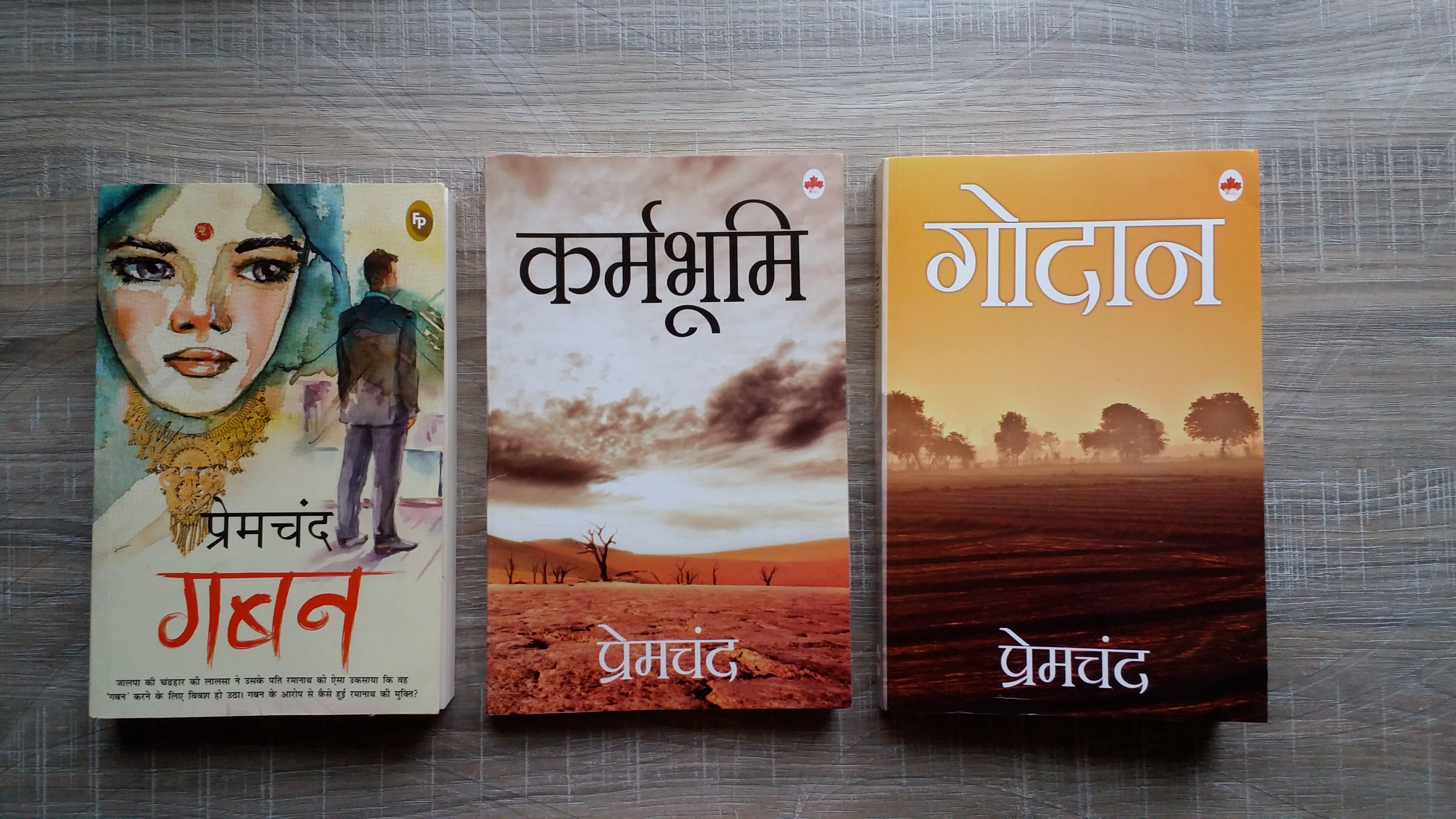
In his novel Karmabhoomi, Munshi Premchand writes about how Lala Samarkant, a staunch Hindu fundamentalist and the father of the protagonist Amarkant, breaks bread with the district collector of Haridwar Salim Hakeem (who is also a close friend of Amarkant’s). Such a simple act may mean little today, but in 1932, a Hindu sharing his food with a Muslim was unheard of.
In Karmabhoomi, while Salim offers to cook for Samarkant, the latter puts up a lot of resistance, and in an unguarded moment, admits that though he does not believe in the notion of untouchability or the perception that an upper-caste Hindu will lose his religion if he eats with a Muslim, he does not want to do away with the years of practice his religion has made him undertake.
Later, Samarkant overcomes his hesitation and has dinner with Salim, and the picture of communal harmony is painted with a flourish by the ‘Upanyas Samrat’ or the ‘Emperor among Novelists’ of Hindi literature. In his 1931 novel Gaban too, Premchand describes how a Muslim courtesan Zohra helps the protagonist Ramanath, who gets held by the police in unique circumstances in Kolkata, meet with his wife Jalpa, who comes all the way from Allahabad, and reconcile as well as prevent their marriage from falling apart.
In his other works too Premchand has waxed lyrical about the communal harmony enjoyed by the two major religions prevalent in India. His works speak of the hopes, faiths and aspirations of Plebeians but do not stop short of taking issues that civil society (of the time he set his novels in) is grappling with. The picture of communal equanimity painted by him seems almost utopian given the circumstances that we are living in today and that is why it will not be imprudent to suggest that if he were around in the India of today, Premchand would be put to shame by what he sees.
On 5 August 2020, exactly a year after Article 370 was repealed from the erstwhile state of Jammu and Kashmir in a draconian manner by the Government of India, the ground-breaking ceremony of the Ram Temple in Ayodhya was flagged off by the country’s prime minister Narendra Modi. Although the nation is wrestling with a pandemic at the moment, the decision to invite hundreds of people (the majority of whom were well above the ripe age of sixty) did not raise any eyebrows at all because the event in question was deemed to be historic, almost epoch-making.
The revocation of Article 370 and the building of the Ram Temple in Ayodhya on a disputed land where there had earlier stood the Babri Masjid, were two of the biggest promises the Bharatiya Janata Party had made when they were fishing for votes, both before the 2014 and 2019 Lok Sabha polls and their vote bank predominantly consisting of Hindu fundamentalists will be screaming from their rooftops in delight as they have been finally fulfilled.
What Premchand had written about in his books was a forthright depiction of what Indian society looked like before the joy of Independence and the despair of Partition had been gifted to us. Such putrid remarks as to religion are often missing from his works, in fact, his Karmabhoomi was seen in a luminary sense and as a cicerone because of the way the protagonist Amarkant did not think twice before letting an unhappy marriage with his wife go and instead try to get into nuptial vows with a destitute Mohammedan artisan Sakina. While society begins to shun him for this act, as does his father, Amarkant is left with no alternative but to emigrate to a village near Haridwar where he begins life afresh.
What is shocking regarding this storyline is that such things are still prevalent across our country close to ninety years after the book was released. Untouchability, another evil of society about which the ‘Emperor Among Novelists’ often wrote about, has long been abolished but is still practised in some disadvantaged pockets of the nation. If India has grown by leaps and bounds, it has also stagnated and gone backwards, so to say. In Premchand’s India, policies were devised among religious and caste-based lines and it is shocking that not much has changed today. Although the blame of driving such wedges between us in the past can be conveniently blamed upon our British masters, whom do we hold responsible for such divisive policies today?
However, the point that has to be made here is widely different from the acknowledgement of the fact that religion and caste-based politics will always have takers in India. It is the understanding that we are perhaps the only top economic nation where social development, fiscal progress and campaigns of inclusion are rarely found on a political party’s agenda. Even if a party chooses to pay lip service to these and other issues which directly affect the growth of India, their voters are quite happy to put them aside for communal-flavoured policies. It is a country gone mad, but not all is beyond saving. That political parties have repeatedly used this tool of inciting and flaring us against our brothers, and that we have repeatedly fallen for it, is a deep, black blur in the history of our great nation.
There is no point in blaming just the government or political parties for inciting us based on communal grounds; in fact, it is time we acknowledge that it is our own lack of erudition and refinement has led them to make such fools of us over and over again. Why have we so quickly forgotten the values of loving thy neighbour and all that our grandparents taught us? How did it matter what religion that neighbour practised so long as they were good people with strong morals and ethics? It will not be until we realise that and go back to the India that Premchand had envisioned that political parties will realise that there is nothing that can be won on the grounds of rousing communal or sectional discord anymore.
The grand old man would be turning in his grave if he sees the India of 2020 so vastly different from the India of 1932, yet be extremely surprised with the similarities. It is time we ask ourselves this question as to what exactly we have achieved in the eighty-four years since Premchand passed away and 73 years since we achieved Independence from foreign rule if we have actually grown as a nation.


 Soliloquy
Leave a comment